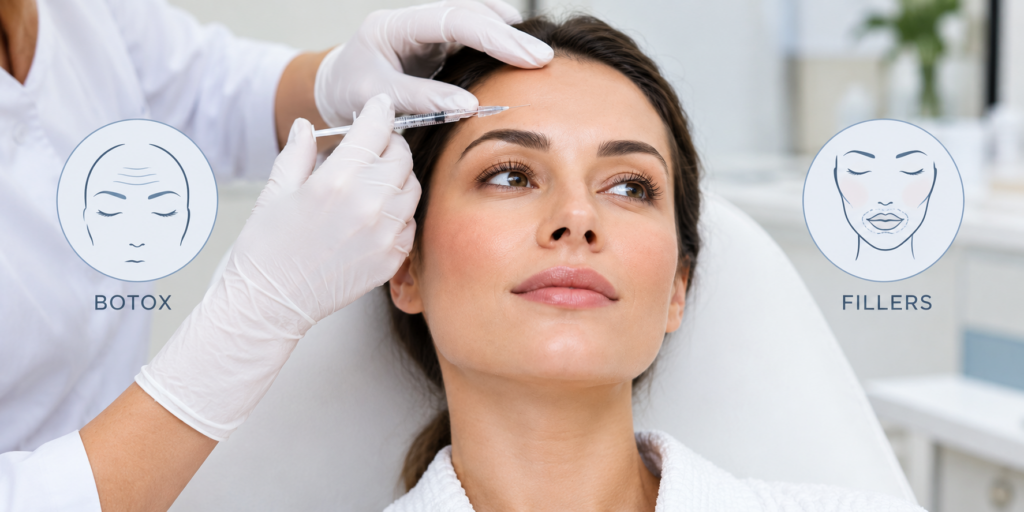
Front desks at dermatology offices hear the same mix-up almost daily: patients request Botox for a concern only filler can fix. That confusion makes sense, since both treatments fall under the broad umbrella of injectables and both promise a smoother, more refreshed appearance.
Still, the real Botox vs. filler difference runs deep, touching how each product is made, what it treats, and how long the final result lasts once fully applied. Botox calms muscle activity beneath expression lines, while filler restores volume the skin has slowly lost over time. Knowing which mechanism fits a specific concern can completely change the outcome.
What Are Botox and Fillers?
Botox involves injecting small amounts of purified botulinum toxin into selected facial muscles. According to the American Academy of Dermatology, this temporarily relaxes the targeted muscles, helping reduce the appearance of fine lines and wrinkles. The treatment weakens the muscles enough to smooth wrinkles while preserving natural facial expressions, with results generally lasting about three to four months, or sometimes longer.
Fillers use a soft, gel-like substance, commonly hyaluronic acid, injected just beneath the skin’s surface to restore lost volume physically. Fillers don’t affect muscle activity; they lift and support hollow or flattened areas from underneath, smoothing creases and rebuilding facial contours that naturally soften with age. Results can often be seen soon after treatment, although the final appearance may take time to develop as swelling settles and the filler integrates with the surrounding tissue.
Botox vs Fillers: Key Differences
The table below shows how Botox and fillers differ, covering what each treats, where it works, and how results tend to show up.
| Category | Botox | Dermal Fillers |
| What it is | Botulinum toxin injected into targeted muscles | Injectable materials used to add volume or improve contours |
| How it works | Temporarily reduces activity in targeted muscles | Adds volume to treated areas |
| Common uses | Frown lines, forehead lines, crow’s feet | Facial folds, hollows, lips, cheeks, chin and other approved areas |
| Best suited to | Wrinkles associated with muscle movement | Volume loss, certain folds, hollows and contour concerns |
| When results appear | Most people see results within 3–5 days | Most fillers provide immediate or near-immediate results |
| How long it lasts | About 3–4 months, sometimes longer | Varies considerably by filler type and treatment area |
| Downtime | Most people return to everyday activities immediately | Most fillers have little or no downtime, though swelling/bruising can occur |
When to Choose Botox or Filler
The right choice depends on what is actually causing the line or hollow you want to address, not on which treatment is more popular.
Signs Botox Fits Your Goals
If lines only show up when you make an expression, like raising your eyebrows or squinting in the sun, Botox is generally the better match. These are movement-based lines that respond well to relaxing the muscle underneath.
Signs Filler Fits Your Goals
If a line stays visible even when your face is completely relaxed, or if an area looks hollow or flat, filler usually works better. Static volume loss needs physical filling, not muscle relaxation. Fillers can replace lost volume and improve facial smoothness and balance.
When a Combination Makes Sense
A mix of both treatments in a single visit benefits patients whose aging affects more than one facial layer. A trained provider can map out a plan that treats movement and volume together.
Botox vs Filler for Wrinkles: Which One Wins for Your Lines
Figuring out which treatment fits your concern starts with watching how the line behaves. If a wrinkle only shows up when you raise your eyebrows, squint, or frown, and disappears once your face goes back to rest, that line is being caused by muscle movement, and Botox is built to address exactly that. Relaxing the muscle underneath stops the repeated motion that deepens the line over time.
If a line remains visible when your face is relaxed, Botox alone may not fully address it. Depending on the cause, filler or another treatment may be more appropriate to restore volume or improve the appearance of the area. Filler physically restores that missing structure from beneath the skin.
This is where much of this debate gets resolved, since the two treatments address entirely different root causes, and many patients end up needing a mix of both once every concern on their face is properly identified.
Once the cause of a wrinkle is identified, choosing the right approach becomes much easier. Coastal Dermatology & Plastic Surgery provides access to skilled dermatologists in Orange, CA, for personalized cosmetic care. Contact us today for a consultation and take the next step toward your aesthetic goals!
Fillers vs. Botox: How Long Do They Last?
Botox generally lasts 3-4 months before the muscle regains its full range of motion and the treated lines slowly return. Full effect takes about two weeks to develop, so patience matters right after treatment.
Filler results can last for varying lengths of time depending on the product used, treatment area, and individual factors. Thicker filler placed in the cheeks generally lasts longer than filler used in thinner-skinned areas like the lips.
The duration can also vary with individual body chemistry, as some people process these treatments faster than others. Lifestyle factors, including sun exposure and physical activity, may also influence how long the effects remain noticeable.
Cost Comparison of Botox and Fillers: What to Budget For
Botox is generally priced according to the amount used, while the total cost can vary by treatment area, provider, and how much product is required. Larger areas or multiple areas may increase the overall expense, and repeat treatments are typically needed to maintain the desired effect over time.
Fillers are commonly priced by the syringe, with costs influenced by the filler type, treatment area, provider, and amount required. Restoring volume in larger areas may require more product, increasing the total cost. Overall cost also depends on how often you need additional treatments to maintain results.
Tips to Get the Best Results From Botox or Filler
A few simple habits before and after treatment help results look natural and last as long as possible.
- Leave the treated area undisturbed after Botox to help keep the product in the correct position.
- Skip strenuous exercise and heavy workouts for about a day after treatment, since raised blood flow can increase swelling or bruising at the injection sites.
- Stay upright and avoid lying flat for several hours after Botox treatment, since this helps keep the product in place and supports even, balanced results.
- Apply ice gently to filler areas if swelling appears after treatment, since cold reduces puffiness without disturbing the placed volume sitting beneath the skin’s surface.
- Hold off on alcohol for a day or two before and after treatment, since alcohol can thin the blood and increase bruising around injection points.
- Give the treatment time to develop before judging the final appearance. Botox results develop gradually, while swelling after filler can temporarily affect how the treated area looks.
- Choose a board-certified provider for either treatment type, since proper injection technique directly affects both safety and how natural the final overall result truly looks.
- Book touch-up appointments on a regular schedule, since staying consistent keeps results looking fresh and prevents lines or volume loss from returning fully.
Frequently Asked Questions
Does Botox or filler hurt more?
Both treatments use a fine needle and cause only mild, brief discomfort for most patients. Numbing cream or ice can further reduce sensation, and neither treatment typically requires extended recovery time.
Do I Need Botox Or Filler?
The right choice depends on how lines behave. Wrinkles that appear mainly with facial movement may respond better to Botox, while lines that remain visible when the face is relaxed may be better suited to filler.
Can Botox and filler be done on the same day?
Yes, Botox and fillers may be used together when appropriate, but the FDA notes that their combined safety has not been evaluated in clinical studies.
Is there any downtime after treatment?
Botox has virtually no downtime, and most people return to normal activity right away. Filler may cause mild swelling or bruising for a few days, though makeup can typically cover it.
How soon will I see results?
Filler shows visible results immediately after injection, while Botox takes about a week to begin working and roughly two weeks for the full effect to show.
Conclusion
The decision between these two treatments depends on matching the right option to the actual concern. Real change happens when movement-based lines receive muscle relaxation and volume loss gets physical support, rather than relying on one treatment to do both jobs. Understanding the Botox vs. filler debate for wrinkles helps clarify which treatment may be more suitable before booking an appointment. A short consultation with a trained provider can then turn that decision into a clear, personalized plan.
Confidence in your own skin starts with the right treatment plan. Coastal Dermatology & Plastic Surgery provides facial fillers in Irvine for patients looking to restore natural volume and softness. Reach out today for a plan tailored to your goals.