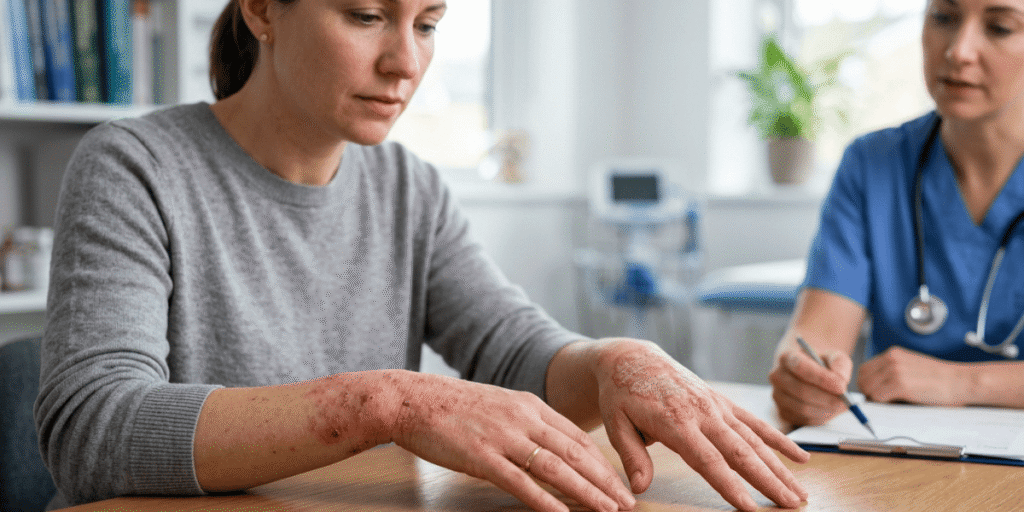
Skin irritation often starts as small, itchy patches that slowly spread, change texture, and become difficult to ignore. Redness, flaking, and discomfort can appear suddenly or build over time, leaving uncertainty about what is happening beneath the skin’s surface. Eczema and psoriasis are common inflammatory skin conditions that often appear similar yet differ in causes, symptoms, and treatment approaches.
Continue reading to explore the comparison of these skin conditions, helping clarify the key features that set each condition apart.
Eczema
Eczema, also called atopic dermatitis, is an inflammatory skin condition that makes the skin dry, itchy, and prone to rashes. It’s closely linked to the immune system, and people with Eczema often also have allergies or asthma. The skin barrier in Eczema sufferers doesn’t function well, which means moisture escapes easily, and irritants sneak in more readily.
It’s incredibly common in babies and young children, though it absolutely affects adults, too. Many kids see their Eczema improve as they grow older, but for others, it’s a lifelong companion.
Psoriasis
Psoriasis is a skin condition that occurs when the immune system becomes overactive. Normally, skin cells grow and shed gradually, but with Psoriasis, the body speeds up this process too much. New skin cells are produced much faster than the old ones can fall off. As a result, the cells build up on the surface of the skin, creating thick, red, dry, and scaly patches called plaques.
Psoriasis is more common in adults than in children, and its severity can vary widely from mild, barely noticeable patches to more serious cases that significantly affect daily life. It is also linked to other health conditions, including psoriatic arthritis, cardiovascular disease, and metabolic disorders.
How to Tell Eczema from Psoriasis: Key Differences at a Glance
- Appearance
| Feature | Eczema | Psoriasis |
| Texture | Soft, weepy, or crusty | Thick, raised, with silvery-white scales |
| Patch edges | Blurry, ill-defined | Sharp, well-defined borders |
| Color | Red, sometimes brownish | Red, silvery, or even purple on darker skin |
| Surface | May ooze or crust during flares | Dry, scaly plaques |
| Nails | Rarely affected | Pitting or thickening of nails is common |
- Location on the Body
- Eczema loves skin folds: the inner elbows, the backs of the knees, the neck, the wrists, and the ankles. In babies, it commonly shows up on the cheeks and scalp.
- Psoriasis tends to appear on the outer surfaces: elbows, knees, the scalp, and the lower back. The palms, soles, and nail beds are also common sites where it can develop.
- The Itch Factor
- Eczema: The itch is intense, sometimes unbearable, and tends to get worse at night. It’s the kind that disrupts sleep and makes it nearly impossible to leave your skin alone.
- Psoriasis: The itch is there, but it feels different. Most people describe it less as a classic itch and more as a burning or stinging sensation on the skin. This is something worth flagging to your dermatologist, as it can influence which psoriasis treatment options are right for you.
- Age of Onset
- Eczema: It usually shows up early, sometimes in infancy, and commonly through childhood. Many kids carry it into adulthood, while others see it ease up over time.
- Psoriasis: It arrives later in life for most people, most commonly between the ages of 15 and 35, but it can develop at any age.
What Causes Each Condition?
Understanding the root cause helps explain why the treatments differ so dramatically.
Causes of Eczema
The exact cause isn’t fully pinned down, but it’s a combination of:
- Genetics: Having a family history of Eczema, asthma, or hay fever raises the risk of developing Eczema.
- Immune overreaction: The immune system responds to harmless substances as if they were threats.
- A weakened skin barrier: The skin can’t retain moisture properly, making it vulnerable.
- Environmental triggers: Dust mites, pet dander, pollen, mold, certain fabrics, fragrances, harsh soaps, and even emotional stress can all set off a flare.
Causes of Psoriasis
A specific immune system error drives Psoriasis:
- Autoimmune dysfunction: T-cells (a type of white blood cell) mistakenly attack healthy skin cells.
- Genetics: About a third of people with Psoriasis have a family member with the condition.
- Common triggers: Stress, skin injuries (the Koebner phenomenon), certain medications like beta-blockers or lithium, infections (especially strep throat), alcohol, and smoking.
Can You Have Both at the Same Time?
Yes, and it’s more common than most people realize. Having both Eczema and Psoriasis simultaneously is entirely possible. The conditions don’t cancel each other out; they add to the complexity of managing your skin. Which is exactly why the differences between eczema and psoriasis matter so much, and why a board-certified dermatologist is the only one who can really sort it out for you.
Eczema Treatment Guide: What Actually Works
There’s no cure for Eczema, but the right strategy can keep it well-controlled and allow you to live comfortably.
- Moisturize, Moisturize, Moisturize
The cornerstone of any Eczema management plan is restoring the skin barrier and using thick, fragrance-free emollients and moisturizers, especially right after bathing. This locks in moisture and helps the skin defend itself. Ceramide-based moisturizers are particularly effective.
- Identify and Avoid Triggers
Writing down when flare-ups happen and what happened before them can help you notice patterns and possible triggers. Common culprits can be hot showers or baths, wool and synthetic fabrics, fragranced products, certain foods (especially in children), and stress and anxiety
- Topical Corticosteroids
When a flare hits, topical corticosteroids are the go-to first step. They bring down inflammation and ease the itch within days, and come in different strengths: mild over-the-counter hydrocortisone for sensitive areas, stronger prescription formulas for thicker, more stubborn patches.
- Non-Steroidal Topical Options
For people who want to avoid long-term steroid use, there are solid alternatives:
- Topical calcineurin inhibitors: Great for sensitive spots like the face and neck.
- PDE4 inhibitors: A steroid-free anti-inflammatory option for mild to moderate Eczema.
- Topical JAK inhibitors: Effective when other topicals haven’t delivered enough relief.
- Phototherapy
When Eczema is widespread and topical treatments aren’t cutting it, controlled exposure to ultraviolet light (phototherapy) can reduce inflammation. It typically requires two to three sessions per week.
- Biologics and Systemic Medications
For moderate to severe cases, biologics have changed the game. Dupilumab (Dupixent) was the first approved for Eczema. It quiets the specific immune signals causing inflammation without shutting down your whole immune system. Oral options like upadacitinib (Rinvoq) and abrocitinib (Cibinqo) are also available and work fast, sometimes easing the itch within days.
If your skin hasn’t responded to what you’ve tried so far, that’s not a dead end. Our dermatologists at Coastal Dermatology & Plastic Surgery build personalized eczema treatment plans around your skin type and conditions.
Psoriasis Treatment Options: A Comprehensive Look
Just as with Eczema, Psoriasis has no permanent cure, but available psoriasis treatment options have advanced significantly, and many people achieve clear or nearly clear skin with the right approach.
- Topical Therapies (Mild to Moderate Psoriasis)
- Topical corticosteroids: The most commonly prescribed first-line treatment, used to reduce inflammation and slow skin cell buildup.
- Vitamin D analogs (like calcipotriol): Help normalize skin cell production and are often paired with steroids.
- Retinoids (tazarotene): A topical vitamin A derivative that slows cell growth.
- Salicylic acid: Softens and helps remove the scaly buildup on plaques.
- Coal tar: An older treatment that reduces scaling, itching, and inflammation.
- Phototherapy (Moderate to Severe Psoriasis)
Phototherapy is a highly effective option for Psoriasis that has spread beyond small patches. Options include:
- Narrowband UVB therapy: The most commonly used form, requiring sessions two to three times per week.
- PUVA (Psoralen + UVA): A combination of a light-sensitizing agent and UVA light, effective for stubborn cases.
- Systemic (Oral) Medications
For people who don’t respond to topicals or light therapy:
- Methotrexate: One of the most widely used systemic options for moderate to severe Psoriasis.
- Cyclosporine: Used for rapid control of severe flares.
- Acitretin: An oral retinoid particularly useful for certain Psoriasis subtypes like guttate or pustular Psoriasis.
- Biologics (Advanced Psoriasis)
This is where Psoriasis treatment has seen the most dramatic evolution. Biologics are precision therapies that target specific parts of the immune system responsible for psoriasis:
- TNF-alpha inhibitors (adalimumab, etanercept, infliximab): Some of the earliest biologics approved for Psoriasis, these work by blocking a protein that drives inflammation throughout the body.
- IL-17 inhibitors (secukinumab, ixekizumab): These target a specific inflammatory pathway closely linked to Psoriasis and are known to clear plaques effectively.
- IL-23 inhibitors (guselkumab, risankizumab): The newer generation. They work deeper in the immune chain and tend to produce longer-lasting skin clearance with fewer doses over time.
When Should You See a Dermatologist?
If you’re dealing with any of the following, it’s time to make an appointment:
- Your rash has persisted for more than two weeks
- Over-the-counter treatments aren’t giving any relief
- Your skin condition is affecting your sleep or daily life
- You’re noticing joint pain alongside skin symptoms (a possible sign of psoriatic arthritis)
- Your skin is cracking, bleeding, or showing signs of infection
- You’re simply unsure what you’re dealing with
Frequently Asked Questions (FAQs)
1. Can Eczema turn into Psoriasis?
No. Eczema and Psoriasis are different skin conditions, but some people can have both at the same time.
2. Is Psoriasis contagious?
No, Psoriasis is not contagious. You cannot catch it through touch or contact. The same is true for Eczema.
3. How to tell eczema from psoriasis?
Psoriasis usually causes thick, scaly patches that may burn or sting. Eczema is often itchier and can make the skin feel dry and sensitive.
4. Can diet affect Eczema or Psoriasis?
Yes, certain foods may trigger flare-ups in some people. Eating less processed food and avoiding personal triggers may help.
5. How long do treatments take to work?
Most treatments start showing results within a few weeks, but some may take a couple of months for full improvement.
Bottom Line
Living with Eczema or Psoriasis is genuinely difficult, but it’s manageable with the right diagnosis and care plan. The debate of eczema vs psoriasis differences go far beyond how they look. They differ in their causes, their triggers, where they appear on the body, and crucially, how they’re treated. Using the wrong approach is not just ineffective, but it can mean years of unnecessary discomfort.
The smartest step you can take is getting a proper diagnosis from a specialist who truly knows skin. With today’s advances in dermatology, including powerful biologics and targeted therapies, most people can achieve significant relief and reclaim their quality of life.
Your skin deserves proper care, not guesswork. Coastal Dermatology & Plastic Surgery provides customized care plans for effective psoriasis and Eczema care. Book your appointment today.