If you live in Southern California, sun exposure isn’t seasonal. It is a daily reality. Year-round warmth, clear skies, and an outdoor lifestyle mean your skin is consistently exposed to UV radiation, often without you realizing it. That cumulative exposure is exactly why skin cancer screening in Southern California is an important part of preventive health care.
Skin cancer is the most common cancer in the United States, and 1 in 5 Americans will be diagnosed with it in their lifetime. Early diagnosis can significantly improve treatment success for most skin cancers. A professional skin exam is one of the simplest tools you have to stay ahead of it. The real question is not that you should get screened; it is how often.
How a Full-Body Skin Cancer Screening Is Performed
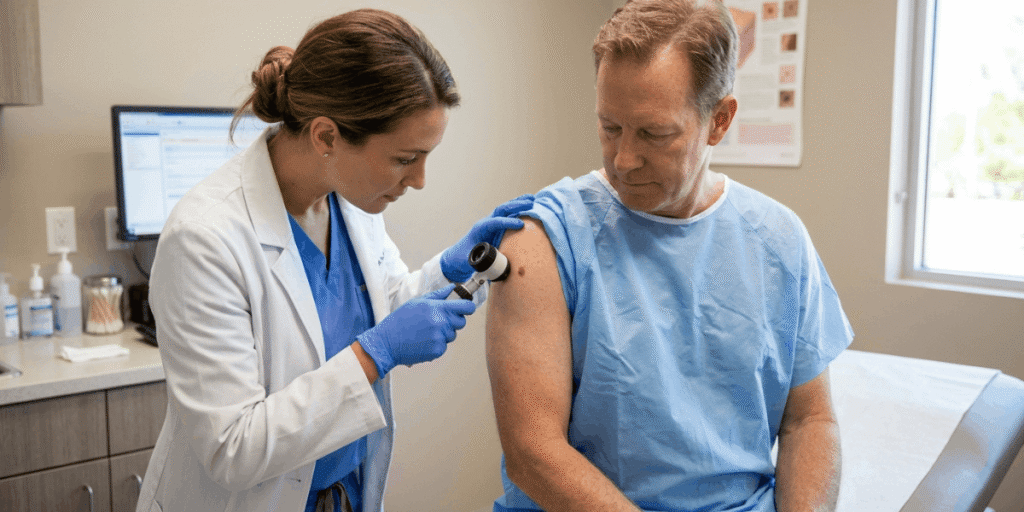
A full-body screening is a thorough head-to-toe examination by a board-certified dermatologist covering the scalp, face, neck, chest, back, arms, legs, feet, and nails. Many dermatologists use a dermatoscope, a handheld device that reveals patterns beneath the skin that are invisible without specialized magnification, helping to distinguish harmless spots from those that need further investigation.
Most screenings take 15 to 30 minutes and are completely painless. If a concerning lesion is identified, your dermatologist may recommend a biopsy during the same visit or at a follow-up appointment.
How Often You Should Get a Skin Check from a Dermatologist in California
Screening frequency depends on personal risk level. Here is a straightforward breakdown to guide your schedule.
Average Risk
No personal or family history of skin cancer and skin that tans more easily than it burns puts you in the average-risk category. There is no universal recommendation for routine skin cancer screening in average-risk adults. Many dermatologists recommend periodic skin examinations based on individual risk factors, sun exposure history, and physician guidance. Given Southern California’s year-round UV exposure, annual skin examinations are often recommended, particularly for individuals with significant cumulative sun exposure.
Moderate Risk
Fair skin, light-colored eyes, a tendency to burn easily, a history of significant sunburns, a family history of melanoma, or numerous moles (especially atypical moles) may increase your risk of skin cancer. For these individuals, annual skin examinations are often recommended. For these patients, an annual skin exam in Los Alamitos, CA, or at any qualified dermatology practice is the standard recommendation.
High Risk
A personal history of melanoma, basal cell carcinoma, or squamous cell carcinoma significantly raises your chances of developing another skin cancer. Immunocompromised individuals, those who have had radiation therapy, or individuals with very high mole counts (often cited as 100 or more) may require closer dermatologic monitoring. This group typically needs professional exams every three to six months.
Post-Treatment Monitoring
After skin cancer treatment, your follow-up schedule is determined by your physician based on cancer type and individual health factors. Consistent monitoring is a critical part of long-term recovery.
Children and Teens
Sun damage begins in childhood. Parents should discuss skin health with their child’s physician early, and teens with a family history of skin cancer or tanning bed use benefit from early dermatology visits.
When to Start
Skin examinations can be performed at any age when concerning lesions, significant risk factors, or physician recommendations warrant evaluation. Adults of any age with new or changing spots, a history of sun damage, or known risk factors should schedule a dedicated dermatology visit without delay.
What Is Responsible for 90% of All Skin Cancers
Ultraviolet (UV) rays from natural sunlight and tanning beds are considered major contributors to the vast majority of skin cancers. UV rays damage DNA in skin cells, and when that damage accumulates without proper repair, it leads to uncontrolled cell growth.
Southern California’s year-round sunshine means constant UV exposure through everyday activities, outdoor dining, commuting, yard work, and recreation. Even on cloudy days, UVA rays penetrate glass and clouds, making daily protection a non-negotiable habit.
The Top 3 Skin Cancers You Should Know
Basal cell carcinoma is the most common skin cancer in the United States, with millions of cases diagnosed and treated annually. It typically appears as a pink or brown, pearly bump on sun-exposed areas such as the face, neck, or ears. BCC rarely spreads but can cause significant local damage if left untreated.
Following basal cell carcinoma, squamous cell carcinoma is the next most common type of skin cancer and affects hundreds of thousands to more than a million Americans each year, depending on the reporting methodology used. It often presents as a firm, red, scaly patch or open sore on sun-exposed skin and carries a higher risk of spreading than BCC, especially when detected late.
Melanoma is the most serious form and accounts for the majority of skin cancer deaths. It can originate in an existing mole or develop as a new dark spot, and it has a greater potential to spread to other parts of the body than most other common skin cancers. Identifying a condition at an early stage contributes to better treatment outcomes.
Warning Signs of Melanoma You Should Never Ignore
Dermatologists use the ABCDE rule to identify early warning signs of melanoma.
- A is for Asymmetry: one half of the mole does not match the other.
- B is for Border: edges are irregular, ragged, or blurred.
- C is for Color: uneven shades of brown, black, red, white, or blue within one lesion.
- D stands for Diameter: a spot larger than 6 mm, roughly the size of a pencil eraser.
- E is for Evolution: any noticeable change in size, shape, color, or appearance needs immediate evaluation.
If you notice any of these signs, do not wait for your next scheduled visit. Book an appointment right away.
Self-Exams Between Professional Screenings
Professional skin cancer screenings and monthly self-exams complement one another. While a dermatologist can identify subtle warning signs that may be difficult to spot on your own, regular self-checks help you detect new lesions or changes between appointments. Performing a monthly skin exam can increase your familiarity with your skin and make it easier to notice any unusual changes.
Inspect your skin in a well-lit area using a full-length mirror and a handheld mirror to examine difficult-to-see areas such as the scalp, back, and the back of the neck. Pay attention to new skin growths, persistent wounds, or moles that gradually increase in size, shape, color, or texture. Regularly taking photos of your skin can help identify changes over time and provide useful information during dermatology visits.
If you notice any suspicious or evolving spots, do not wait until your next scheduled screening. Early dermatologic assessment can help identify potential skin cancers at a stage when treatment is often simpler and more effective.
Why Southern California Residents Need to Be Especially Proactive
Most of the country gets seasonal relief from UV exposure. Southern California does not, and residents accumulate decades of sun exposure through everyday outdoor activities. This makes dermatology in Huntington Beach, CA, and throughout the region a genuinely important part of preventive health care, not just a cosmetic concern.
Coastal Dermatology & Plastic Surgery also offers the facelift, a transformative surgical procedure for patients seeking a more refreshed and youthful appearance, with personalized consultations and advanced techniques designed to deliver natural-looking results. Schedule a consultation today.
Frequently Asked Questions
How often should I get a full-body skin cancer check?
Recommended screening timelines differ based on personal risk factors and medical history. Many dermatologists recommend annual skin examinations for adults with significant sun exposure or elevated risk factors. High-risk patients or those with a previous skin cancer diagnosis should be seen every three to six months, or as directed by their dermatologist.
What is responsible for 90% of all skin cancers?
Exposure to UV light from sunlight and tanning beds is considered a major contributing factor in the vast majority of skin cancers.
What are the top 3 skin cancers?
The top three skin cancers are basal cell carcinoma, squamous cell carcinoma, and melanoma. Basal cell carcinoma is diagnosed most frequently, while melanoma is responsible for most deaths caused by skin cancer.
What are the warning signs of melanoma?
The ABCDE rule covers the key signs: asymmetry, irregular borders, uneven color, a diameter larger than 6mm, and any evolution or change over time.
Conclusion
Protecting your skin in Southern California starts with knowing your risk level, scheduling screenings at the right frequency, and staying consistent with monthly self-exams. Skin cancer screening in Southern California is an ongoing commitment, not a one-time appointment. The earlier skin cancer is found, the simpler and more effective the treatment.
Coastal Dermatology & Plastic Surgery also provides expert plastic surgery services, with customized treatment plans and surgical expertise designed to help patients achieve their aesthetic goals with confidence. Contact our team to book an appointment.