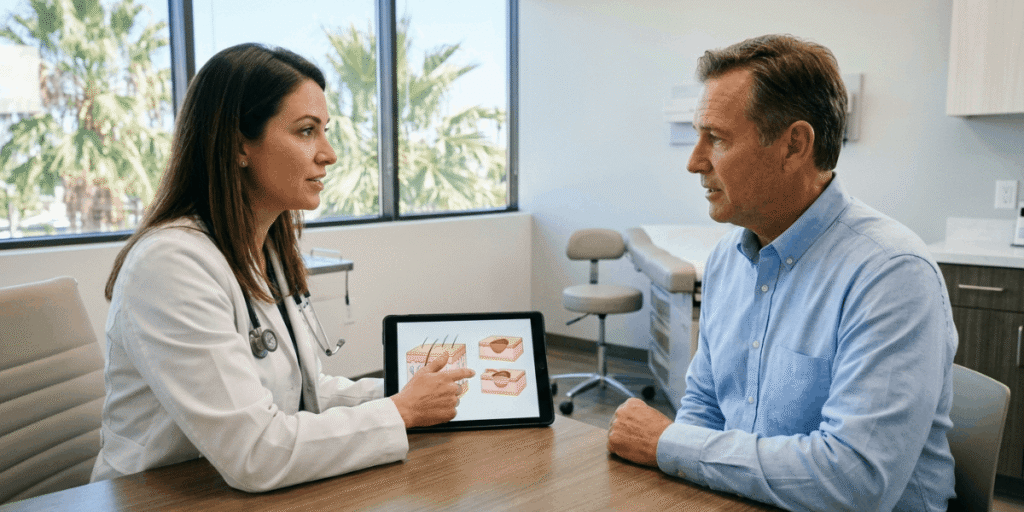
A skin cancer diagnosis raises immediate and serious questions. How serious is it? What happens next? And most importantly, what is the most effective treatment? Two of the most commonly recommended procedures are Mohs surgery and surgical excision. Both are proven and widely used, but they are not the same, and the right choice depends entirely on your specific situation.
For patients exploring their options for skin cancer removal in Southern California, this guide covers how each procedure works, who is the ideal candidate, and what realistic outcomes look like.
What Is Mohs Surgery?
Mohs micrographic surgery is a highly precise, tissue-conserving method for treating skin cancer. The procedure involves removing the visible tumor along with an extremely thin layer of surrounding tissue, which is immediately examined under a microscope in the office. If cancer cells remain at the edges, another thin layer is removed only from that specific area. This process repeats until the margins are completely clear.
Because the entire peripheral and deep surgical margin is examined during the procedure, Mohs surgery provides the highest level of confidence that all detectable cancer has been removed before the patient leaves. This is what makes Mohs surgery in Huntington Beach, California, so highly regarded. Mohs surgery achieves cure rates approaching 99% for many primary basal cell carcinomas and 97–99% for selected squamous cell carcinomas. For certain in situ melanomas and selected thin melanomas treated with specialized Mohs techniques, reported cure rates are also very high.
What Is Standard Surgical Excision?
Standard surgical excision is the more traditional approach. The procedure involves removing the visible tumor along with a pre-measured border of surrounding healthy tissue, which is then sent to an outside pathology lab. Results typically return within a few days.
With excision, not all margins are examined during the procedure. If the pathology report later shows cancer cells at the edge of the removed tissue, a second surgery may be needed. Excision works very well for many skin cancers, particularly low-risk tumors on the trunk, arms, or legs, where preserving every millimeter of tissue is less critical.
The Core Differences of Mohs Surgery vs Excision of Skin Cancer
When comparing Mohs surgery and excision for skin cancer, a few key factors stand out to help guide your decision.
Margin Control
Mohs evaluates the entire peripheral and deep margins of the excised tissue in real time, whereas standard pathology evaluates representative sections of the specimen after the procedure, which samples only a portion of the tissue. This is the main reason Mohs achieves higher cure rates for complex or high-risk skin cancers.
Tissue Preservation
Mohs removes tissue only where cancer remains, preserving more healthy skin. This matters greatly on the face, ears, nose, eyelids, and scalp, where tissue loss affects both appearance and function. Excision removes a wider, predetermined margin that may include more healthy tissue than necessary.
Procedure Length
Mohs surgery typically takes several hours due to the microscopic analysis performed between each stage. Standard excision is faster at the initial visit, but a second procedure may be needed if pathology shows positive margins.
Cure Rates
For basal cell and squamous cell carcinoma in high-risk areas, Mohs generally achieves higher cure rates. Excision still delivers strong results for lower-risk lesions. Standard surgical excision achieves excellent cure rates for appropriately selected tumors, typically exceeding 90% for both basal cell and squamous cell carcinomas.
Cost
Mohs surgery has higher upfront costs due to specialized training and real-time tissue processing, and its lower recurrence rate makes it more cost-effective over time. Both procedures are covered by most PPO insurance plans and Medicare when medically necessary.
Which Type of Skin Cancer Requires Mohs Surgery?
Mohs is most commonly recommended in the following situations:
- Basal cell carcinoma on the face, ears, or scalp
- Squamous cell carcinoma that is large, recurrent, or in a functionally important area
- Previously treated skin cancers that have returned
- Tumors with aggressive or poorly defined growth patterns
- Cancers near cosmetically sensitive areas such as the nose, lips, or eyelids
For melanoma in situ and certain thin melanomas in select locations, Mohs surgery may be considered at specialized centers, but most invasive melanomas are treated with standard wide local excision. If your skin cancer is low-risk, such as a small, well-defined basal cell carcinoma on the shoulder, standard excision may be entirely appropriate and equally effective.
What Factors Influence the Decision?
Choosing between these two procedures is never a one-size-fits-all decision. A board-certified dermatologist weighs several factors before making a recommendation.
Tumor Location
Locations near the eyes, mouth, or ears require extra precision because even a small amount of tissue loss can affect function or appearance. In these areas, Mohs is almost always preferred.
Tumor Size and Borders
Larger tumors and those with poorly defined borders are harder to fully remove with standard excision. Mohs surgery follows the cancer’s exact shape rather than cutting a generic margin, making it better suited for these cases.
History of Previous Treatment
If a skin cancer has recurred after excision or another method, Mohs becomes the stronger recommendation. Recurrent cancers often grow in irregular patterns beneath the skin that are not visible during standard surgical planning.
Cosmetic Priorities
For patients concerned about scarring in visible areas, Mohs often preserves more healthy tissue, which can help optimize reconstructive and cosmetic outcomes. Scar quality also depends on wound size, repair method, and sun protection during healing.
What I Wish I Knew Before Mohs Surgery
Many patients wish they had been better prepared for the day. The appointment can last several hours, with waiting periods between stages as the tissue is processed. You remain awake throughout, as the procedure is performed under local anesthesia.
The wound may also look larger than expected. Skin cancer can extend further beneath the surface than it appears, so the final wound size sometimes surprises patients. This simply reflects how thoroughly the cancer was removed. The recovery timeline is generally one to two weeks, depending on wound size and closure method.
Seeking treatment early has a significant impact on outcomes and recovery. Coastal Dermatology & Plastic Surgery offers comprehensive skin cancer care, personalized treatment recommendations, and expert eczema treatment for patients across Southern California.
What Are the Downsides of Mohs Surgery?
Mohs surgery requires specialized training, so it is not available at every practice. It takes longer than standard excision and carries higher upfront costs, though insurance coverage applies in most medically appropriate cases.
Rare complications include temporary nerve changes, bruising, infection, and pigmentation differences at the surgical site. These potential complications are less common when performed by a knowledgeable and experienced, board-certified surgeon.
Finding the Right Care in Southern California
Living in Southern California means year-round sun exposure, making regular skin checks and early detection especially important. Excessive ultraviolet (UV) exposure is a major risk factor for developing skin cancer, and prompt evaluation of suspicious moles, lesions, or non-healing sores can help improve treatment outcomes. Patients seeking skin cancer treatment in Los Alamitos, CA, have access to board-certified dermatology specialists who diagnose and treat a wide range of skin cancer types, including basal cell carcinoma, squamous cell carcinoma, and melanoma.
Treatment recommendations vary depending on the type of skin cancer, its size and location, and if it has been treated before. While Mohs surgery is often recommended for high-risk or cosmetically sensitive areas, standard surgical excision remains an effective option for many low-risk tumors. A thorough evaluation by a qualified dermatologist can help recommend the most appropriate treatment strategy based on each patient’s individual circumstances.
Frequently Asked Questions
Is Mohs surgery better than excision?
For high-risk skin cancers in sensitive areas, Mohs is generally the superior option due to higher cure rates and complete margin control. For low-risk tumors in non-sensitive areas, standard excision is often equally appropriate.
Which type of skin cancer requires Mohs surgery?
Mohs surgery is most commonly recommended for basal cell and squamous cell carcinomas, especially when the tumor is large, recurrent, or located in a cosmetically critical area.
What I wish I knew before Mohs surgery?
Plan for a full day, expect waiting periods between stages, and know that the final wound may be larger than the visible lesion. The procedure is done under local anesthesia, so you stay awake and comfortable throughout.
What is the new treatment instead of Mohs?
Radiation, topical immunotherapy, and photodynamic therapy are available for select cases, but Mohs surgery is often considered the treatment of choice for many high-risk or recurrent non-melanoma skin cancers in cosmetically or functionally sensitive areas.
What are the downsides of Mohs surgery?
It requires specialized training, takes longer than excision, and carries higher upfront costs. Rare complications include nerve changes and scarring, which are minimized with an experienced surgeon.
Conclusion
Choosing between Mohs surgery and standard excision does not have to feel overwhelming. The right answer depends on your cancer type, location, size, and health history. In high-risk scenarios, Mohs surgery in Huntington Beach, California, and across Southern California offers the most precise and effective path forward. For lower-risk cases, standard excision remains a reliable and practical option.
Taking the next step toward better skin health starts with expert evaluation. Coastal Dermatology & Plastic Surgery offers expert evaluation and comprehensive care for basal cell carcinoma, squamous cell carcinoma, melanoma, and a variety of other skin cancers, and other dermatologic conditions, including specialized psoriasis treatment. Book your consultation today.